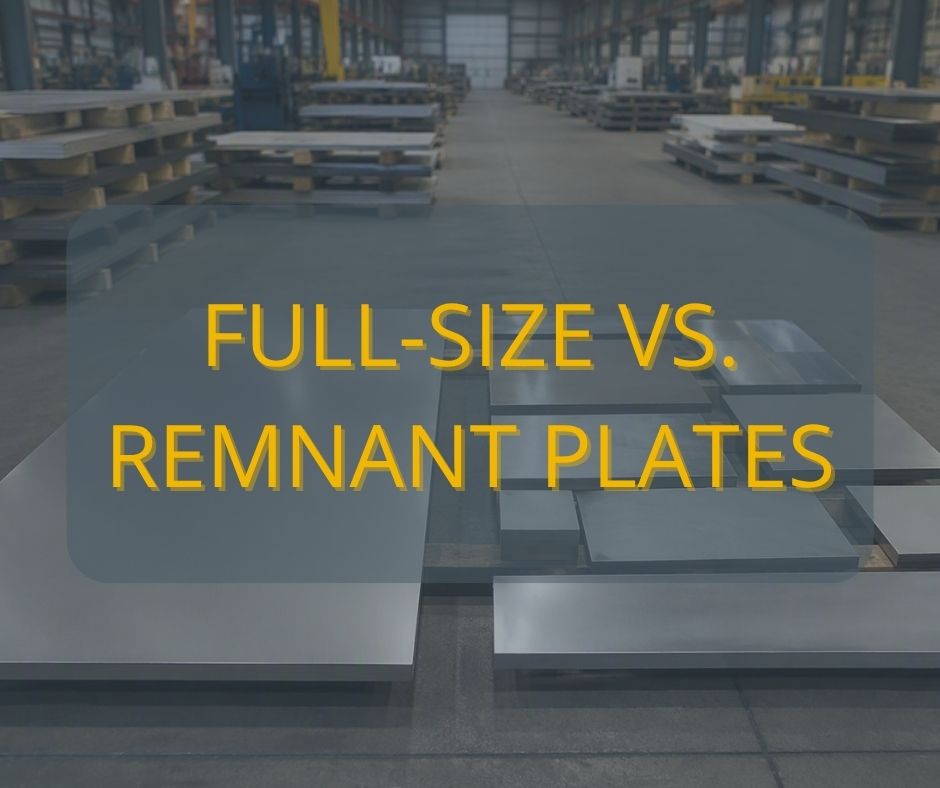
In today’s industrial market, controlling material costs is more important than ever. Procurement teams, fabricators, machine shops, OEMs, and manufacturers are under constant pressure to meet production schedules while maximizing every dollar spent on raw materials.
Yet one simple purchasing decision is often overlooked: Does this project require a full-size plate, or would a remnant plate accomplish the same goal at a lower cost?
For buyers of stainless steel plates and nickel alloy plates, understanding the difference can lead to substantial savings, reduced waste, and improved material utilization, all without compromising quality, traceability, or performance.
The most effective buyers aren’t simply purchasing material. They’re purchasing the right amount of material for the job.
Understanding Full-Size Plates
A full-size plate is a standard mill-produced plate stocked in common dimensions and thicknesses.
Typical sizes include:
- 48″ × 96″
- 48″ × 120″
- 60″ × 120″
- 72″ × 144″
- Other mill-standard dimensions depending on grade and thickness
Full-size plates remain the preferred choice for many manufacturing and fabrication applications because they offer flexibility, inventory consistency, and the ability to support multiple production runs.
When Full-Size Plates Make Sense
Full-size plates are typically the best option when:
- Multiple parts will be cut from the same plate
- Production volumes are high
- Material will be consumed across future jobs
- Standard inventory is maintained on-site
- Nesting efficiencies can maximize material usage
For manufacturers with recurring demand, purchasing a full-size plate often provides greater long-term value than sourcing material one project at a time.
Advantages of Full-Size Plates
Production Flexibility
Larger plate dimensions allow manufacturers to adapt quickly when project requirements change or additional parts are needed.
Improved Nesting Opportunities
Cutting multiple components from one plate can improve material utilization and reduce overall scrap.
Reliable Inventory Strategy
Keeping commonly used grades in stock helps support production continuity and reduce disruptions.
What Are Remnant Plates?
Remnant plates are the remaining portions of larger plates left after cutting operations. While the dimensions are smaller than standard mill sizes, the material itself remains the same.
A remnant plate maintains:
- The same grade
- The same mechanical properties
- The same corrosion resistance
- The same traceability
- The same material certifications
The difference is size, not quality.
This is an important distinction because many buyers mistakenly assume remnant material is somehow inferior. In reality, a remnant plate may come from the exact same plate as a full-size piece delivered to another customer.
Why More Buyers Are Considering Remnants
When a project requires a relatively small component, purchasing an entire plate may create unnecessary cost and excess inventory.
Instead, a remnant plate may provide:
- Lower overall material spend
- Reduced scrap generation
- Better material utilization
- Faster turnaround for small jobs
- Less unused material sitting on shelves
For prototype work, repairs, maintenance projects, and short production runs, remnants can be an exceptionally efficient purchasing strategy.
Full-Size Plate vs. Remnant Plate: A Practical Comparison
| Consideration | Full-Size Plate | Remnant Plate |
| Initial Material Cost | Higher | Lower |
| Material Utilization | Varies by project | Often higher |
| Ideal for Production Runs | Excellent | Limited |
| Ideal for Prototypes | Less economical | Excellent |
| Future Inventory Value | High | Limited |
| Excess Material Risk | Higher | Lower |
| Material Quality | Full mill quality | Same mill quality |
| Traceability | Yes | Yes |
The smartest choice isn’t always the least expensive option upfront. It’s the option that delivers the lowest total material cost for the project.
A Simple Question That Can Save Thousands
Before ordering material, buyers should ask:
How much of this plate will actually be used?
Consider a project requiring several small stainless steel components. Purchasing a full-size plate may leave a significant amount of material unused after cutting.
If a suitable remnant plate is available, the buyer may receive the same grade, certifications, and performance requirements while purchasing substantially less material overall.
For organizations focused on cost control, inventory reduction, and lean manufacturing, those savings can add up quickly across multiple projects throughout the year.
Real-World Applications Across US Industries
Aerospace Manufacturing
Aerospace suppliers often produce low-volume, high-value components. When fixture plates, tooling, or support structures require smaller dimensions, remnant material can help reduce costs without affecting project requirements.
Defense and Military Programs
Replacement components, maintenance work, and specialized fabrication frequently involve limited quantities. Remnant plates can provide an economical solution while maintaining strict material traceability requirements.
Food Processing Equipment
Manufacturers of food-grade equipment commonly use corrosion-resistant stainless steel for tanks, guards, brackets, and support structures. Smaller projects may not justify purchasing a full-size plate.
Industrial Fabrication
Custom fabricators rarely encounter identical jobs. Having access to a broad inventory of both full-size and remnant plates allows them to purchase material based on actual project needs instead of standard stock sizes.
Machine Shops
Machine shops focused on custom machining often require smaller starting blanks. A properly sized remnant can reduce material waste before machining even begins.
Why Supplier Inventory Matters
Not every supplier maintains a diverse remnant inventory.
The actual value of remnant purchasing depends on having access to a broad range of:
- Thicknesses
- Grades
- Plate dimensions
- Stainless steel products
- Nickel alloy products
A supplier with extensive inventory can often match a project with a remnant that closely fits the required dimensions, helping customers reduce costs while maintaining schedule flexibility.
This is where inventory depth becomes a competitive advantage.
Cutting Capabilities Create Additional Savings
Material optimization doesn’t stop with plate selection.
Advanced processing capabilities can further reduce waste, labor, and handling costs by delivering material closer to the dimensions required for production.
At JACQUET, customers benefit from:
- Extensive stainless steel inventory
- Nickel alloy inventory available locally
- Full-size plates and remnant plates
- Precision cutting capabilities
- Responsive local service
- Fast quotation turnaround
- Support from a global stainless steel and nickel alloy group
By combining the right starting material with the right processing capabilities, buyers can often reduce both material costs and internal processing time.
The Same Principle Applies to Bars
The concept extends beyond plates.
Many buyers purchase full lengths of stainless steel bars and nickel alloy bars when only a portion of the material is required.
Working with a trusted bar stock supplier USA manufacturers rely on can help optimize purchases through:
- Cut-to-length bars
- Improved material utilization
- Reduced machining preparation time
- Lower freight costs
- Reduced inventory carrying costs
Whether the product is plate or bar stock, the goal remains the same: purchase material that fits the application, not simply the standard stock size.
Smart Material Purchasing Starts with the Right Conversation
The most effective procurement professionals evaluate more than price per pound. They consider:
- Material utilization
- Waste reduction
- Processing costs
- Inventory carrying costs
- Delivery requirements
- Future material demand
In many cases, a remnant plate can provide the best overall value. In others, a full-size plate remains the smarter long-term investment.
The key is working with a supplier that offers both options and understands how to match inventory to the application.
Conclusion
There is no universal answer to the full-size versus remnant plate question. The right choice depends on the project, required dimensions, production volume, and future material needs.
What is universal, however, is the importance of maximizing material utilization and minimizing unnecessary costs.
With access to a large inventory of stainless steel plates, nickel alloy plates, stainless steel bars, and nickel alloy bars, along with extensive cutting capabilities, JACQUET helps customers identify the most efficient material solution for each application.
Whether you need a full-size plate for production or a remnant plate for a specialized project, contact your nearest JACQUET location to discuss available inventory and find the right fit for your next job.